Enjoying Oliwa Park
2025
in progress
12th century abbey park
Gdańsk, Oliwa
Oliwa Park
There’s this park in the northern part of Gdańsk that most tourists skip because they’re too busy with the Old Town. That’s a mistake. Oliwa Park is 10 hectares of something you won’t find anywhere else — a garden that Cistercian monks started building in the 12th century and that kept getting redesigned by every new owner for the next 800 years. What you walk through today is layer upon layer of ideas about what a perfect garden should look like, from medieval monks to Prussian kings to post-war Polish restorers. And it still works.
What makes it different
I think what surprises people most is that this isn’t a “park” the way you’d expect. It’s an engineered landscape. The Cistercian monks who settled here in 1186 - led by a Dane 🇩🇰 named Bernard Dithard, by the way — didn’t just plant trees. They redirected the Oliwa Stream and built over 20 production facilities along its banks: mills, forges, sawmills. They were industrialists disguised as monks. The park grew out of their monastery gardens, and you can still feel that purposefulness in every corner.
Key features
The french garden & the optical trick
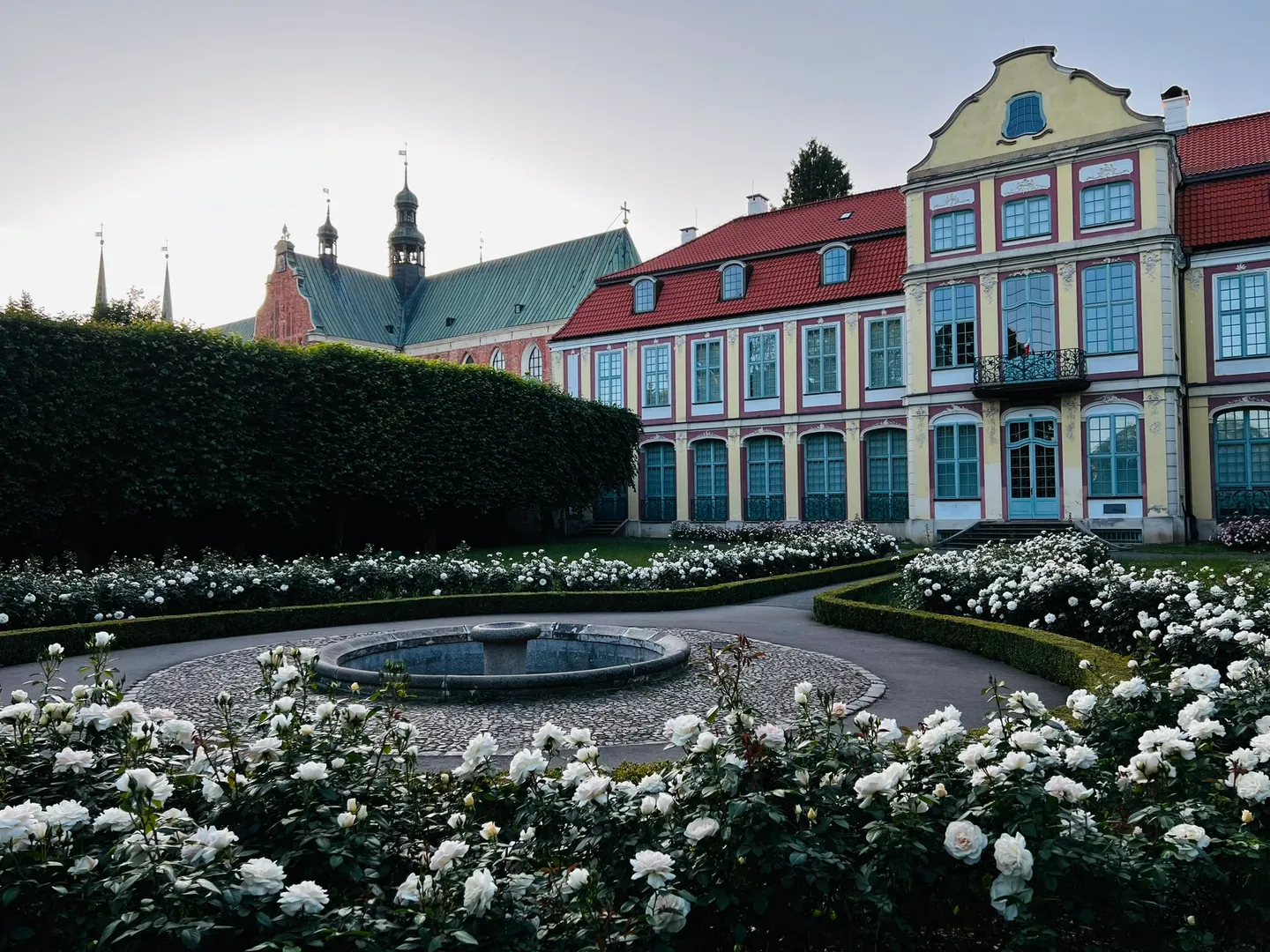
- The central piece is a Baroque French garden modeled after Versailles — literally. In the mid-1700s, the last abbot, Jacek Rybiński, hired a gardener who’d studied Le Nôtre’s designs and previously worked on the gardens at Wilanów Palace in Warsaw.
- There’s a 112-meter alley of trimmed lime trees, about 15 meters tall, that creates a forced-perspective illusion. Standing at the right spot, it looks like the garden connects directly to Gdańsk Bay, several kilometers away. The monks called it the “Road to Freedom.” Some say “Road to Eternity.” Either way, it messes with your depth perception in a way that feels intentional and a little unsettling.
- The geometric boxwood patterns and sculpted yew cones in front of the Abbots’ Palace look formal, but the craftsmanship is genuinely impressive when you see it up close.
The hidden
- On the slopes of an artificial hill, there are 18th-century “Whispering Caves” — acoustic shells built into the rock. Two people standing in separate caves, backs to each other, can hold a conversation in whispers. It’s not a gimmick; it’s deliberate acoustic engineering from 250 years ago. Most visitors walk right past them.
- The park has a “Tri-City Niagara” — a small cascading waterfall where the Oliwa Stream drops over rocks. Kids love jumping stone to stone here, and on hot days it’s the best free entertainment in the district.
- There’s a Palm House that used to be the monks’ winter garden in the 1700s. Inside lives an almost 180-year-old date palm — the oldest in Poland. Entry is free, and it’s tucked next to a café, so most people stumble into it by accident.
The stories
- One of the abbots, Michael Antoni Hacki, was reportedly the only person in 17th-century Poland who knew cryptography. He was essentially a spy-abbot, running intelligence operations from a monastery.
- During plague outbreaks, monks sealed themselves inside the monastery but kept one brother in the gatehouse to minister to the sick. When he died, another took his place. Ten monks died this way, one after another. The gatehouse is still called the “House of the Plague.”
- The 1660 Treaty of Oliwa - which ended the Swedish invasion of Poland — was signed right here. Kings like Jan III Sobieski and Władysław Łokietek visited these grounds. This was a political venue disguised as a garden.
Quick facts
- ~10 hectares, part of a larger post-Cistercian complex
- Founded in 1186 by Cistercian monks from Denmark (via Kołbacz)
- French Baroque, English-Chinese, Japanese gardens — all in one park
- Best time to visit - weekday mornings for quiet; winter evenings for light installations
Why it stays with you
The streams reflect the sky differently every hour. There’s a Japanese garden section with sculpted azaleas that feels completely out of place in northern Poland, and somehow that’s the point. Every corner holds something you didn’t expect: a statue, a hidden bench, a flowerbed that wasn’t there last season. I’ve been dozens of times and I still notice new things which is rare for a city park. That’s what 800 years of people caring about a place will do.